Portfolio Owner's Manual · Chapter I
⬡ Moonshots & Speculations

HighRisk,High
Stakes

Asymmetric bets sized as options. Small wagers on large futures — binary outcomes, pre-commercial technology, and early-stage businesses. Not building blocks. Lottery tickets written on real ideas.

What is a Moonshot position?
A deliberately small allocation — typically under 2% NAV — in a company with binary or near-binary potential. Sized so a complete loss is tolerable; a success is transformational. These are held as options, not compounders. The size is the thesis.
14 Holdings · Speculation Tier · 2026
⚠ Risk Notice Most positions in this chapter are early-stage with binary or near-binary outcomes. All are sized small accordingly. Read as speculative long-duration bets, not investments in proven businesses.
01

Space & Communications

Satellite networks · Direct-to-device · Launch infrastructure

ASTS
AST SpaceMobile
🇺🇸
Midland, Texas · NASDAQ
Satellite Telecom
Satellite
Building the first space-based cellular broadband network directly accessible by ordinary, unmodified smartphones — no special hardware required
AST SpaceMobile's B2B2C model partners with mobile operators who pay for coverage in areas where cell towers don't reach. The operator pays ASTS; end users just use their existing phone. As of early 2026, ASTS has partnerships with approximately 60 mobile network operators covering over 3 billion subscribers globally, including AT&T, Verizon, Vodafone, Rakuten, Orange, Telefonica, and stc. The company secured over $1.2 billion in contracted revenue commitments and generated $70.9 million in full-year 2025 revenue. The constellation target is approximately 45 BlueBird satellites in orbit by end of 2026, with launches planned every one to two months on average.

It is important to note that this is very early-stage: revenue is primarily from government contracts and gateway deliveries, not yet from commercial subscriber service at scale. BlueBird 7 was lost following a launch incident in early 2026 — a reminder that execution risk is real and recurring.
Watch These
BlueBird DeploymentSatellite count in orbit — progress to 45
Commercial ServiceRevenue from subscriber-facing MNO contracts
Cash Runway$3.5bn+ cash (Q1 2026) vs launch cadence
If the constellation deploys successfully, commercial MNO service activates, and even a fraction of 3 billion subscribers pay modest premiums for coverage, the revenue potential is transformational. If deployments slip, technology underperforms at scale, or operators don't convert agreements to commercial revenue, cash burns and the position approaches zero. BlueBird 7's loss illustrates the execution risk is not theoretical.
Extreme — Binary outcome
RKLB
Rocket Lab
🇺🇸
Long Beach, California · NASDAQ
Space Launch & Systems
Rocket launch
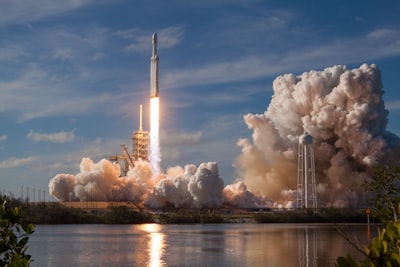
A full-service space company with $602m 2025 revenue, 21 launches at 100% success rate, and Neutron medium-lift rocket targeting Q4 2026 first flight
Rocket Lab is further along than most moonshots — it is a real, growing business. Full-year 2025 revenue was $602 million (38% growth), with a $1.85 billion backlog and its largest-ever contract, an $816 million Space Development Agency award to manufacture satellites. The Electron rocket is the world's most frequently launched small dedicated orbital vehicle, with a 100% annual launch success rate in 2025. The space systems division — building spacecraft end-to-end — is growing rapidly alongside launch.

The speculative element is Neutron: a medium-lift reusable rocket designed to compete with SpaceX in a much larger market. Neutron's first launch is now targeted for Q4 2026 following a stage 1 tank test failure earlier in the year. If Neutron succeeds, Rocket Lab becomes a tier-1 space company. That step-change in scale is why it sits in moonshots despite being profitable on an operational basis in some segments.
Watch These
Neutron MilestonesDevelopment progress toward Q4 2026 launch
Backlog Growth$1.85bn — visibility into future revenue
Electron CadenceLaunch frequency — core revenue engine
Rocket Lab has real revenue but remains pre-profitability at group level and is burning cash on Neutron development — a multi-billion-dollar programme competing directly with SpaceX in medium-lift. If Neutron succeeds, the total addressable market expands dramatically. If development stumbles further or SpaceX pricing makes medium-lift economics difficult, the speculative upside evaporates even as the core Electron business compounds.
Very High — Neutron execution risk
02

Computing Frontiers

Quantum computing · Next-generation semiconductors

IONQ
IonQ Inc.
🇺🇸
College Park, Maryland · NYSE
Quantum Computing
Quantum hardware
The first public quantum company to surpass $100m annual revenue — trapped-ion technology gaining commercial traction, but profitability remains years away
IonQ is further along than the "10 years away" quantum narrative suggests. Full-year 2025 revenue was $130 million — 202% year-on-year growth — making it the first publicly traded quantum company to exceed $100 million in annual GAAP revenue. 60% of that revenue came from commercial customers, not just government contracts. IonQ has also expanded into quantum networking, sensing, and security, and announced the acquisition of SkyWater Technology to strengthen its semiconductor manufacturing capabilities.

The company uses trapped-ion qubits — individual charged atoms suspended in electromagnetic fields — as its computing medium, achieving 99.99% two-qubit gate fidelity (a world record for commercial systems). Systems are available via AWS, Azure, and Google Cloud. Despite this progress, IonQ remains loss-making. The company guides for $225–245 million in 2026 revenue. The speculative element is whether quantum advantage — where quantum genuinely outperforms classical computers on real business problems — materialises at commercial scale this decade.
Watch These
Algorithmic Qubits (#AQ)IonQ's quality metric — Tempo targets AQ 64+
Commercial Revenue %Non-government share — 60% in 2025
Cash Runway$3.3bn cash end-2025 — well-funded
The bull case: IonQ has crossed $100m revenue faster than any quantum company, commercial adoption is accelerating, and the technology roadmap (Tempo system, AQ 64+) is on track. The bear case: current revenue is largely from customers experimenting with quantum rather than deploying it commercially, gate fidelity improvements may plateau before fault-tolerant quantum computing is achievable, and IBM, Google, and Microsoft all have competing approaches. Sized as an option on a decade-long technology transition.
Extreme — Technology timeline uncertain
ENSI
EnSilica plc
🇬🇧
Oxford, England · AIM
Fabless Semiconductors
Semiconductor chip
A UK fabless chip designer specialising in bespoke mixed-signal ASICs for automotive, industrial, healthcare and communications — micro-cap with lumpy revenue
EnSilica designs custom application-specific integrated circuits (ASICs) for customers who need chips built to a specific purpose rather than general use. Mixed-signal ASICs — combining digital and analogue functions on one chip — are the most complex type to design and carry high barriers to entry. Customers span automotive Tier 1 suppliers, industrial OEMs, telecoms companies, and defence. EnSilica also holds a portfolio of core IP in cryptography, radar, and communications, providing some product revenue alongside design services. Government contracts, including UK Department of Defence work, validate the quality of its engineering.

Revenue in FY2025 declined to approximately £18m following a stronger FY2024, reflecting the project-timing risk inherent in a services-led ASIC business. Market cap is approximately £37m — micro-cap territory where institutional coverage is sparse.
Watch These
Revenue RecoveryFY25 decline — is the pipeline rebuilding?
Design Win PipelineNew ASIC contracts — long lead times
IP Revenue MixShift toward recurring licensing
EnSilica is a micro-cap in a capital-intensive, long-cycle business. ASIC design projects take years and a single large customer shifting timelines causes sharp annual revenue swings — as FY2025 demonstrated. The long-term case is compelling (bespoke chips structurally valuable, IP portfolio adds upside), but the path to consistent profitability at scale requires sustained contract wins and progression from services toward product revenue.
Very High — Micro-cap, lumpy revenue
MU
Micron Technology
🇺🇸
Boise, Idaho · NASDAQ
Memory Semiconductors
Memory chips
The world's third-largest memory chip maker — a commodity cyclical business with a real HBM/AI opportunity, but no switching costs and structurally exposed to pricing cycles
Micron designs and manufactures DRAM and NAND flash memory — the components enabling computers and data centres to store and rapidly access data. It is a cyclical, commodity-like business where profitability swings dramatically with global memory pricing dynamics rather than Micron's own execution. The specific AI opportunity: high-bandwidth memory (HBM) is a specialised DRAM product used to feed data to AI accelerators like NVIDIA's GPUs, and Micron is a leading HBM supplier alongside Samsung and SK Hynix. As AI infrastructure scales, HBM demand grows with it.

Despite this opportunity, Micron lacks a durable moat. Memory is a commodity — when oversupply hits, as it cyclically does, margins collapse regardless of AI demand. There is no switching cost, no proprietary ecosystem, and no pricing power in down cycles.
Watch These
HBM Revenue ShareAI memory as % of total
DRAM Pricing CycleIndustry price direction — dictates margins
Gross Margin %Key profitability signal — highly volatile
Memory is a commodity and Micron lacks a durable competitive advantage. The HBM opportunity is contested by Samsung and SK Hynix, both with significantly greater manufacturing scale. In normal memory downturns, margins collapse across all three players simultaneously regardless of AI tailwinds. The fundamental question for investors: is HBM a durable structural differentiation, or does pricing eventually commoditise even high-bandwidth memory as supply scales?
High — Commodity cycle, no moat
"These are options, not investments. The size is the thesis."
Moonshots are not managed like the rest of the portfolio. There is no DCF, no earnings multiple that meaningfully applies. The question isn't "is this cheap?" — it's "is this worth a small bet on a large future?" Each position is sized so a complete loss is tolerable. The discipline is in not letting them grow unchecked when they run.
03

AI Infrastructure & Digital Assets

AI cloud computing · Bitcoin mining · Next-generation battery technology

NBIS
Nebius Group
🇳🇱
Amsterdam · NASDAQ
AI Cloud
Data centre
A GPU-focused AI cloud platform rebuilt from Yandex's international assets — now holding $46bn+ in contracted backlog from Microsoft and Meta
Nebius was formed from the non-Russian assets of Yandex following international sanctions, relisted on NASDAQ, and redeployed as an AI-native GPU cloud platform. The transformation has been dramatic: from near-zero revenue to $1.25 billion annualised recurring revenue by end of 2025 (385% growth), with capacity sold out in every quarter. Microsoft signed a contract valued at $17.4–19.4 billion and Meta signed a $2.9 billion contract — both representing dedicated GPU infrastructure over multi-year terms. These contracts provide extraordinary revenue visibility but also concentrate significant customer exposure in two relationships.

Nebius is targeting $7–9 billion ARR by end of 2026 — management's own stated guidance, not independent analysis — requiring a five to seven-fold increase in ARR within one year. That target depends on 800MW to 1GW of connected data centre capacity coming online on schedule.
Watch These
ARR Growth$1.25bn end-2025 — tracking toward guidance
Capacity DeploymentMW connected — revenue ceiling
Governance NewsAny Russia-adjacent complications
Despite full legal separation from Russia's Yandex, the historical ownership connection creates a persistent governance concern for some institutional investors. The Microsoft and Meta contracts represent strong commercial validation, but the overhang on multiple re-rating remains. If it fully clears, the upside is significant. The $7–9bn ARR guidance for 2026 is extremely ambitious — execution on capacity deployment is the binding constraint. Customer concentration in two hyperscalers is also a structural risk.
Very High — Governance + customer concentration
IREN
Iris Energy
🇦🇺
Vancouver ops / Sydney · NASDAQ
BTC Mining / AI Data
Data centre cooling
A renewable-powered data centre operator pivoting from Bitcoin mining toward AI compute — but the pivot is very early: AI revenue is still a small fraction of total
Iris Energy builds and operates data centres powered predominantly by renewable energy — originally for Bitcoin mining, now beginning a strategic pivot toward GPU hosting for AI. The renewable energy angle is a genuine differentiator: power purchase agreements lock in below-market electricity rates in British Columbia, Alberta, and Texas. As AI infrastructure scrutiny around power consumption grows, clean-energy compute may command premium pricing.

However, it is important to be clear about where this pivot currently stands. In May 2025, AI Cloud Services generated $2.2 million in monthly revenue versus $64.7 million from Bitcoin mining. AI is growing rapidly (from ~$0.8m monthly in late 2024) but remains a small fraction of total operations. By mid-2025 IREN had approximately 4,300 NVIDIA GPUs deployed including Blackwell. The Horizon 1 AI data centre came online in late 2025. This is a bet on whether the AI transition scales quickly enough before Bitcoin economics or broader macro shifts create pressure.
Watch These
AI Revenue vs BTCMonthly AI share — watch the ratio shift
GPU Count DeployedBlackwell/H100 capacity online
Power Cost / MWhRenewable energy structural cost edge
The vast majority of IREN's current earnings remain tied to Bitcoin price. FastGraphs and conventional valuation metrics are unreliable here — earnings are dominated by BTC price volatility rather than business fundamentals. If Bitcoin collapses and the AI pivot hasn't scaled sufficiently, this becomes a distressed asset. Monitor the AI revenue transition monthly. The thesis only holds if the AI proportion grows meaningfully within the next 12–18 months.
Very High — BTC correlated + transition risk
AMPX
Amprius Technologies
🇺🇸
Fremont, California · NYSE
Battery Technology
Battery tech
Silicon-anode batteries with up to 450 Wh/kg energy density — now generating revenue with first-ever positive gross margins, targeting aerospace and defence
Amprius replaces the graphite anode in lithium-ion batteries with silicon nanowires, producing cells with up to 450 Wh/kg specific energy density — significantly higher than conventional lithium-ion at 250–300 Wh/kg. This makes them substantially lighter for a given energy capacity, a critical advantage in weight-sensitive aerospace applications. The company has been producing commercial batteries since 2018 and reached a significant milestone in Q2 2025: positive gross margins for the first time, with $15.1 million in quarterly revenue. A $35 million purchase order from a leading UAS manufacturer followed a prior $15 million order earlier in 2025. Airbus's AALTO subsidiary (high-altitude pseudo-satellites) has used Amprius cells on record-breaking 67-day stratospheric flights.

The beachhead market is aerospace, defence, and unmanned aviation — customers with lower price sensitivity and genuine need for the performance advantage. The longer-term prize is electric vehicles, but that requires manufacturing cost parity that has not yet been achieved.
Watch These
Revenue GrowthQuarterly trajectory — now commercially scaling
Gross MarginFirst positive in Q2 2025 — must sustain
Manufacturing Cost$/kWh reduction — path to EV market
Silicon anode commercialisation has been a decade-long challenge. Amprius has now crossed into profitability at small scale, but scaling manufacturing to cost-competitive GWh volumes is the unresolved question. The battery space is highly competitive — Enovix, Sila Nanotechnologies, and others are pursuing similar technology. Amprius's advantage is aerospace validation and existing customer relationships, but EV-scale economics remain unproven.
Very High — Manufacturing scale uncertain
04

Defence & Autonomous Systems

Subsea robotics · AUV component supply · Niche defence technology

KRKNF
Kraken Robotics
🇨🇦
St. John's, Newfoundland · OTC
Subsea Defence Tech
Underwater robotics
Sonar sensors and pressure-tolerant batteries for Anduril's entire autonomous underwater vehicle portfolio — positioned as a critical subsystem supplier as AUV programmes scale
Kraken Robotics provides synthetic aperture sonar systems and Seapower pressure-tolerant lithium batteries for naval defence and commercial subsea applications. The core thesis is its role as a primary component supplier for Anduril's autonomous underwater vehicles — the Dive-LD, Ghost Shark (Dive-XL), Copperhead, and Seabed Sentry platforms. Kraken technology is integrated across Anduril's entire subsea portfolio. Each Dive-LD carries approximately CAD $2 million of Kraken components; each Ghost Shark approximately CAD $10 million (these are community estimates, not Kraken's official disclosures). Anduril opened a 150,000 sq ft AUV production facility in Quonset Point, Rhode Island in 2025, capable of over 200 Dive-LD hulls per year. Australia's A$1.7 billion Ghost Shark programme of record was awarded in September 2025, with deliveries beginning in early 2026. Kraken Q3 2025 revenue surged 60% year-on-year to $31.3 million CAD with record gross margins.
Watch These
Anduril Production RateAUV hull count — Kraken revenue scales with it
Revenue GrowthQuarterly CAD — tracking ramp trajectory
Programme WinsUS Navy / allied nation AUV contracts
The bull case depends substantially on Anduril executing its AUV programme at scale and on timeline. A programme delay, design change that reduces Kraken content, or competing supplier entering the supply chain materially changes the revenue path. The component value figures cited above are community estimates — Kraken has not publicly disclosed exact content-per-hull values. OTC listing and Canadian domicile suppress institutional buyer access. Size accordingly.
High — Programme dependency + OTC
05

Consumer & Emerging Markets

Chinese EV disruption · Designer collectibles · LatAm consumer bets

1211
BYD Company (H-Share)
🇨🇳
Shenzhen, China · HKEX (1211.HK)
Electric Vehicles
Electric vehicle
China's dominant EV manufacturer — 4.6 million NEVs delivered in 2025 — now pushing aggressively into European markets as Tesla faces brand headwinds
BYD delivered 4.6 million new energy vehicles in 2025, becoming the first automaker globally to surpass 15 million cumulative NEV sales. Unlike Western EV makers, BYD is uniquely vertically integrated: it manufactures its own batteries (Blade Battery technology), semiconductors, and motors, giving it cost advantages that are structurally difficult for competitors to replicate. In China, BYD commands dominant market share across multiple price points. Full-year 2025 revenue was RMB 804 billion, though net income declined approximately 20% reflecting margin pressure and competitive intensity in the domestic market.

The international thesis — particularly Europe — is where the speculation lies. BYD overtook Tesla in European EV registrations in August 2025. It is expanding its UK showroom network and negotiating to acquire underused European manufacturing plants to mitigate EU tariffs. The tariff overhang and geopolitical uncertainty between the EU and China remain the primary risks.
Watch These
European Sales VolumeMonthly EU registrations — expansion proxy
EU Tariff DecisionsRegulatory risk is the primary overhang
Net Profit MarginMargin compression in China is the warning sign
EU tariffs on Chinese EVs directly impact BYD's European expansion economics. The 2025 earnings decline — net income down ~20% despite revenue growth — signals domestic margin pressure from intensifying competition with local Chinese brands including Geely. BYD is building a factory in Hungary to produce EVs locally and reduce tariff exposure, but timelines are long. Categorised as speculation because outcome depends heavily on geopolitical and regulatory factors outside BYD's operational control.
Very High — Geopolitical + tariff + margin
9992
Pop Mart International
🇨🇳
Beijing, China · HKEX / FRA
Designer Collectibles
Collectible toys
China's designer toy phenomenon going global — 2025 revenue of RMB 37 billion (+185%), Labubu viral in the US, but fad risk and IP concentration remain the key questions
Pop Mart designs, manufactures, and sells collectible designer toys including the blind-box format where buyers don't know which character they'll receive until it's opened. Full-year 2025 revenue surged 185% to RMB 37.1 billion, driven almost entirely by the Labubu phenomenon — the pointy-eared "Monsters" character that became a global social media sensation. International markets now account for approximately 40% of revenue and are growing rapidly: Americas revenue grew over 1,000% year-on-year in Q1 2025, US TikTok Shop revenue grew 1,828% in the year to June 2025. Pop Mart operated over 630 stores globally at year-end 2025 across 100 countries.

This is a remaining position after a partial sale. The key question is whether Pop Mart can sustain beyond the Labubu moment — building a genuine multi-IP global lifestyle brand, or proving to be a single-character phenomenon. IP diversification is improving: six IPs exceeded RMB 2 billion in 2025 revenue. But Labubu still represents an outsized share.
Watch These
Non-Labubu IP RevenueDiversification beyond The Monsters
International Revenue %Currently ~40% — trajectory matters
Operating MarginSustaining margins through international expansion
Collectible toy brands can be intensely fashionable and then sharply unfashionable. The blind-box mechanic has attracted regulatory scrutiny in China for gambling-like characteristics. Labubu's viral success in the US could normalise or fade faster than growth assumptions require. Pop Mart's share price fell significantly from its 2025 peak as investors questioned whether the Labubu moment was sustainable. The durability of the brand beyond a single character is the central question for long-term investors.
Very High — Fad risk + IP concentration
06

Biotech, Clean Tech & Deep Science

Psychedelic medicine · Green hydrogen · Advanced fission

ATAI
AtaiBeckley
🇩🇪
Berlin / Oxford · NASDAQ
Psychedelic Medicine
Medical research
A Phase 3-ready clinical-stage biopharma — combining atai and Beckley Psytech to build a global leader in rapid-acting psychedelic mental health therapies
In 2025, atai Life Sciences completed a strategic merger with Beckley Psytech to form AtaiBeckley — a combined clinical-stage biopharma focused on psychedelic-assisted therapy for treatment-resistant mental health conditions. The lead programme is BPL-003 (mebufotenin benzoate, an intranasal 5-MeO-DMT formulation) for treatment-resistant depression, which met its primary and all key secondary endpoints in a Phase 2b trial in 2025 — the largest controlled trial of this compound to date. The pipeline also includes VLS-01 (buccal film DMT) and EMP-01 (oral R-MDMA for social anxiety disorder), both in Phase 2 development. Cash is funded into 2027. Christian Angermayer and Peter Thiel are major backers.

The science behind psychedelic-assisted therapy has demonstrated meaningful efficacy for conditions that have resisted conventional pharmacology for decades. BPL-003's Phase 2b success positions AtaiBeckley as Phase 3-ready with a potentially first-in-class rapid-acting treatment.
Watch These
BPL-003 Phase 3Trial design and FDA engagement — key milestone
Cash RunwayFunded into 2027 — watch burn rate
EMP-01 / VLS-01 DataPhase 2 readouts expected 2026
Psychedelic medicine remains a regulatory frontier. No psychedelic-based therapy has yet received full FDA approval, though the regulatory environment has been evolving. Clinical trial failures are common in biotech, and Phase 3 is significantly larger and costlier than Phase 2. BPL-003's Phase 2b success is encouraging but not determinative. This is a small, early bet on a potentially large paradigm shift in psychiatric treatment.
Extreme — Regulatory + Phase 3 risk
HGRAF
HydroGraph Clean Power
🇨🇦
Calgary, Canada · OTC
Green Hydrogen / Graphene
Clean energy
A detonation-based process that co-produces hydrogen and high-purity graphene simultaneously — genuinely early-stage, pre-revenue, and one of the most speculative positions in the portfolio
HydroGraph has developed a proprietary detonation technology that simultaneously produces hydrogen gas and high-purity graphene from a single process. Graphene — a single layer of carbon atoms — is theoretically one of the strongest, most conductive materials ever discovered, with potential applications across batteries, composites, electronics, and construction. The production cost problem has historically made graphene commercially unviable at scale. HydroGraph's thesis is that co-producing hydrogen and graphene from one energy input changes the economics fundamentally. Very small position. Pre-revenue. OTC-listed micro-cap.
Watch These
Graphene Purity% purity — key commercial quality metric
Production Cost$/kg vs market alternatives
Offtake AgreementsAny commercial contracts — first validation
HydroGraph is pre-revenue, micro-cap, OTC-listed, and operating in a space where graphene commercialisation has been promised for fifteen years without broad delivery. The detonation process is novel and the IP is real, but the path from laboratory curiosity to commercial product at scale is long and uncertain. Best understood as a long-duration option on a possible materials science breakthrough — appropriate only at very small allocations.
Extreme — Pre-revenue, OTC, unproven at scale
OKLO
Oklo Inc.
🇺🇸
Santa Clara, California · NYSE
Advanced Fission
Nuclear energy
Building compact advanced fission power plants for AI data centres — NRC approved core design criteria in 2026, has broken ground at Idaho National Laboratory
Oklo is developing the Aurora powerhouse — a compact fast reactor targeting 15–75 MWe output — designed for factory manufacturing and deployment at specific sites. The primary market is AI data centres, which require always-on baseload power and face growing pressure to decarbonise. Nuclear is uniquely attractive here: zero carbon emissions, minimal land footprint, uninterruptible output. Sam Altman is a backer and former board member. Customers include Equinix (PPA signed) and Oklo has partnerships with NVIDIA and Los Alamos National Laboratory.

The regulatory picture has improved materially since the 2022 NRC licence rejection. Oklo has broken ground at Idaho National Laboratory under DOE authorisation (a separate pathway from standard NRC licensing for the first unit). The NRC approved Oklo's Principal Design Criteria topical report in May 2026 — an accelerated review — clearing the design framework for future licensing applications. First commercial operation is targeted for late 2027 or early 2028.
Watch These
INL Construction ProgressFirst Aurora deployment — primary milestone
PPA PipelinePower purchase agreements — commercial validation
DOE / NRC PathwayRegulatory progress on COLA submission
The situation has evolved significantly since the 2022 rejection. The first Aurora at INL is proceeding under DOE authorisation rather than the standard NRC framework — a faster pathway. The NRC approved the Principal Design Criteria topical report in May 2026, streamlining future licensing. However, nuclear construction is inherently complex and first-of-a-kind construction risk is real. Commercial operation in 2027–2028 requires everything to proceed on schedule — unlikely to be perfectly smooth. This remains a long-dated option on advanced nuclear power.
Very High — Construction + regulatory timeline
Chapter I Summary · All Moonshots at a Glance
TickerCompanySectorThe BetRisk
ASTSAST SpaceMobileSatellite Telecom~60 MNO partner network — space-based mobile coverage at scale●●●●●
RKLBRocket LabSpace Launch$602m 2025 revenue — Neutron medium-lift rocket targeting Q4 2026●●●●○
IONQIonQ Inc.Quantum Computing$130m 2025 revenue — first quantum company to $100m, path to profitability●●●●●
ENSIEnSilica plcFabless SemiconductorsUK bespoke ASIC designer — AIM micro-cap, lumpy revenue●●●●○
MUMicron TechnologyMemory SemisHBM AI memory opportunity — commodity cyclical, no durable moat, exposed to pricing cycle●●●○○
NBISNebius GroupAI Cloud$46bn+ contracted backlog from Microsoft & Meta — $1.25bn ARR end-2025●●●●○
IRENIris EnergyBTC Mining / AI InfraRenewable data centres pivoting BTC→AI — pivot very early stage●●●●○
AMPXAmprius TechnologiesBattery Tech450 Wh/kg silicon-anode batteries — first positive gross margins in 2025●●●●○
KRKNFKraken RoboticsSubsea DefenceCritical sonar & battery supplier for Anduril's AUV fleet●●●○○
1211BYD (H-Share)Electric Vehicles4.6m NEVs in 2025 — European expansion bet vs tariff headwind●●●●○
9992Pop MartDesigner CollectiblesRMB 37bn 2025 revenue — Labubu global, fad risk remains real●●●●○
ATAIAtaiBeckleyPsychedelic MedicineBPL-003 Phase 2b success — Phase 3-ready psychedelic therapy platform●●●●●
HGRAFHydroGraph Clean PowerGreen Hydrogen / GrapheneDetonation process co-producing hydrogen and graphene — pre-revenue●●●●●
OKLOOklo Inc.Advanced FissionAurora SMR under construction at INL — commercial operation 2027–2028●●●●○